



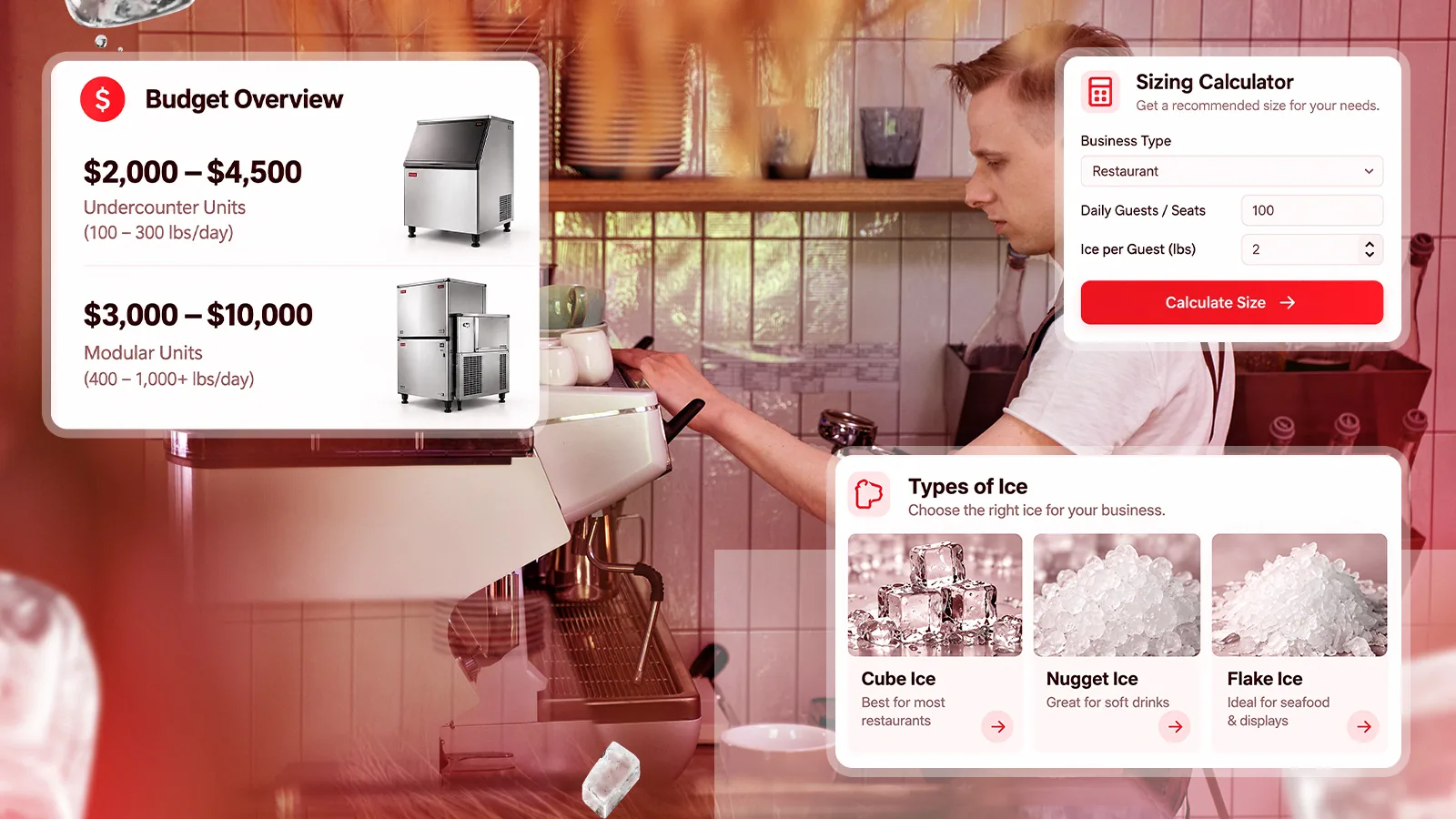
Size a commercial ice machine at 1.5 to 2 pounds of ice per guest per day for a restaurant and 3 pounds per seat for a bar, then buy one size up. Undercounter units make 100 to 300 pounds a day and cost $2,000 to $4,500; modular heads on a separate bin make 400 to 1,000+ pounds and run $3,000 to $10,000 before the bin. Cube ice covers most restaurants, nugget sells soft drinks, and flake belongs on seafood and produce displays. Already know what you need? Shop commercial ice machines.
Ice is the one piece of equipment that runs out in front of customers. When a machine is undersized, the bar goes dry on a Friday at 9 pm; when it’s oversized, you’ve paid for capacity that sits idle. This guide covers the three decisions that matter, in the order they should be made: the type of ice, the pounds per day, and the way the machine sheds heat. It ends with a comparison of the units we keep in stock in Garland and the two installation mistakes that void warranties.
Restaurant Headquarters has supplied and installed ice machines for Dallas-Fort Worth restaurants since 1992, and we design the kitchens they go into. The sizing rules below are the ones we use on our own projects.
In this guide
Types of Commercial Ice Machines
Commercial ice machines come in four formats, and the format is set by where the ice is used, not by how much you need. Production and storage are chosen after that.
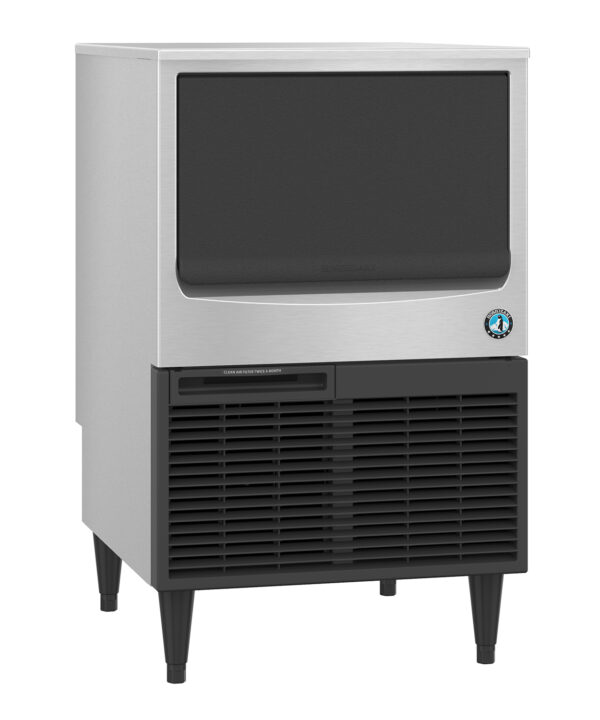
- Undercounter ice machines combine the maker and a small bin in one cabinet that fits under a 40-inch counter. They make 100 to 300 pounds a day and hold 50 to 100 pounds, which suits a bar, a coffee shop, or a small dining room. Browse undercounter ice makers.
- Modular ice machine heads sit on top of a separate storage bin or dispenser. The head makes 300 to 1,000+ pounds a day and the bin you pair it with sets the storage, which is how a full-service restaurant or a hotel gets the volume it needs. Heads and ice bins are sold separately.
- Ice dispensers deliver ice through a chute into a cup or bucket, so nobody scoops from an open bin. They belong in self-serve beverage stations, hotel corridors, and healthcare floors. See hotel ice dispensers.
- Countertop ice and water dispensers are the small-footprint option for offices, waiting rooms, and break rooms where 50 to 100 pounds a day is plenty.
Most independent restaurants in DFW end up with one of two setups: a single undercounter unit at the bar, or a modular head on a 300 to 500 pound bin in the back of house with staff running ice to the stations.
Cube, Nugget, and Flake Ice
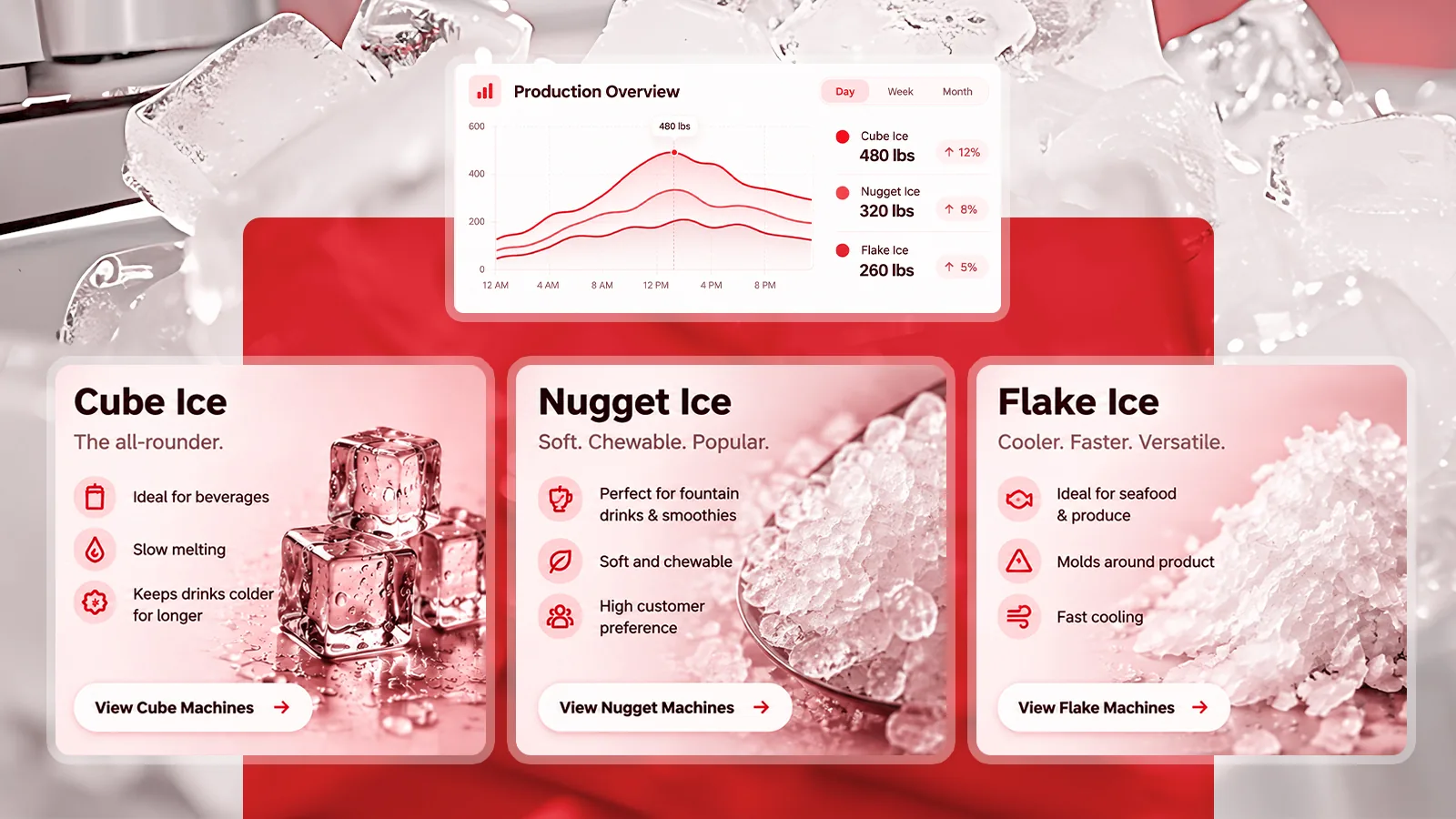
The ice shape decides the machine before anything else, because each shape comes from a different evaporator and a machine makes only one. Cube ice is the default for beverage service; nugget and flake are bought on purpose for specific uses.
| Ice type | What it’s for | Notes |
|---|---|---|
| Crescent and half-dice cube | Soft drinks, water service, iced tea, most cocktails | Hard and slow-melting, so drinks stay cold without watering down. Hoshizaki’s crescent cube and Atosa’s half-dice both fall here. The safe choice for a restaurant with one machine. |
| Full cube and gourmet | Cocktail programs, spirits on the rocks, upscale dining | Larger and clearer, melts slowest, displaces more liquid in the glass. Costs more per pound and takes longer to make. |
| Nugget (chewable) | Fountain drinks, smoothies, tea shops, healthcare | Soft, absorbs the drink, and customers ask for it by name. Uses more ice per drink and the machines cost more per pound of output. |
| Flake | Seafood and produce displays, sushi cases, salad bars, packing | Molds around product and cools fast. Not for drinks. A sushi restaurant usually runs one flake machine for the case and one cube machine for the bar. |
If the menu has a serious cocktail list, plan for two shapes: a cube machine for volume and a small gourmet or full-cube unit at the bar. If it’s a fast-casual concept with fountain drinks, nugget ice is a legitimate sales lever, and it’s why chains standardized on it.
How Much Ice a Restaurant Needs
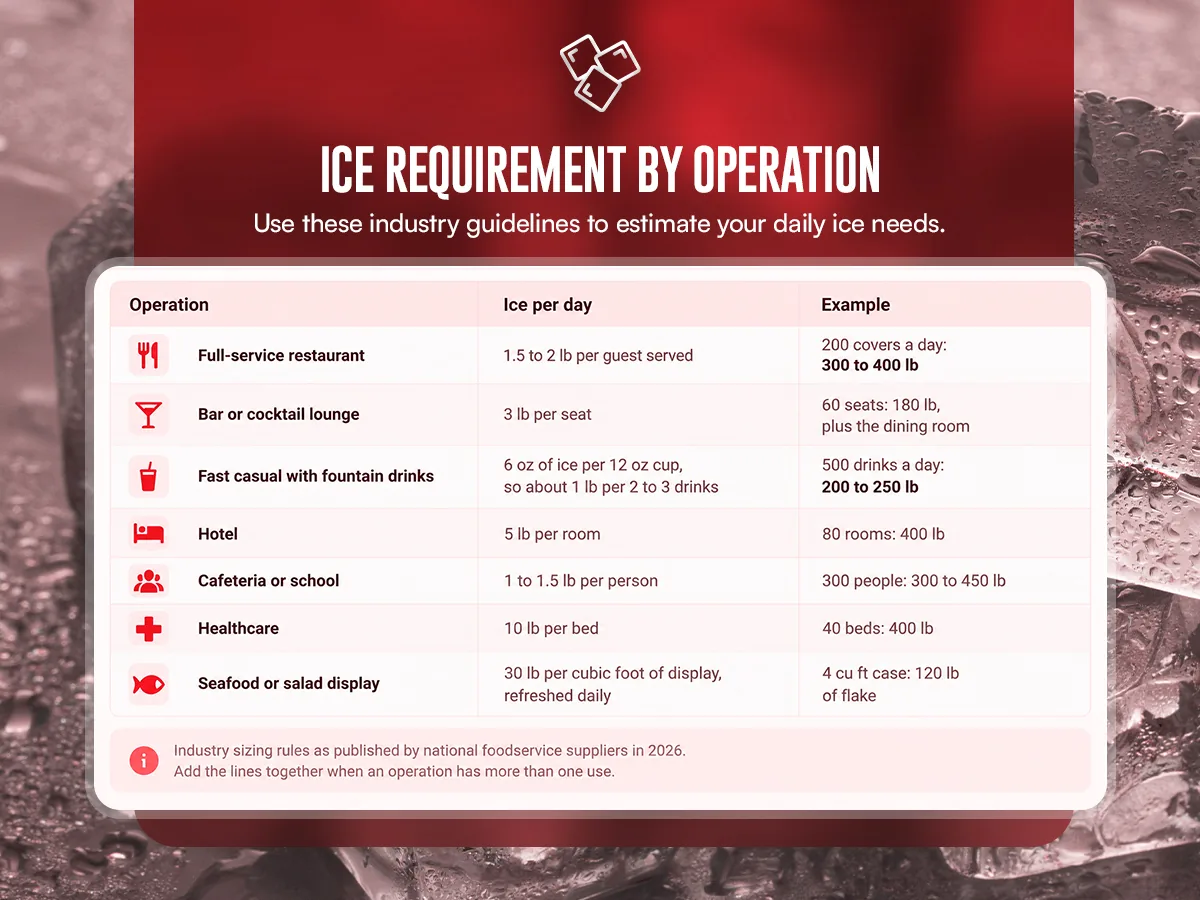
A restaurant needs about 1.5 to 2 pounds of ice per guest per day, a bar needs 3 pounds per seat, and a hotel needs 5 pounds per room. Multiply the rule by your busiest day, not your average one, and buy the next size up from that number.
| Operation | Ice per day | Example |
|---|---|---|
| Full-service restaurant | 1.5 to 2 lb per guest served | 200 covers a day: 300 to 400 lb |
| Bar or cocktail lounge | 3 lb per seat | 60 seats: 180 lb, plus the dining room |
| Fast casual with fountain drinks | 6 oz of ice per 12 oz cup, so about 1 lb per 2 to 3 drinks | 500 drinks a day: 200 to 250 lb |
| Hotel | 5 lb per room | 80 rooms: 400 lb |
| Cafeteria or school | 1 to 1.5 lb per person | 300 people: 300 to 450 lb |
| Healthcare | 10 lb per bed | 40 beds: 400 lb |
| Seafood or salad display | 30 lb per cubic foot of display, refreshed daily | 4 cu ft case: 120 lb of flake |
Industry sizing rules as published by national foodservice suppliers in 2026. Add the lines together when an operation has more than one use.
The Texas correction
Every ice machine’s headline number is measured at 70°F air and 50°F incoming water. The AHRI certified figure on the spec sheet is measured at 90°F air and 70°F water, and that second number is closer to a Dallas kitchen in August. On the units we stock the difference is 12 to 20 percent: the Hoshizaki KM-116BAJ is rated at 125 pounds a day and AHRI certified at 100, and the KMD-530MRJZ is rated at 498 and certified at 440. Size from the AHRI number if the machine is going anywhere near the cook line, and size from the headline number only if it’s in a cool, ventilated back room.
Bin sizing
The bin should hold at least a full day’s production and never less than what you’ll pull during the peak service. A 500 pound-a-day head on a 300 pound bin runs full and idle overnight, then can’t keep up when the dinner rush pulls 200 pounds in two hours. When in doubt, buy the bigger bin; it’s the cheapest part of the system.
Not sure what size? Send us your seat count
Tell us the concept, the seats, and where the machine will sit. We’ll size it, pick the bin, and quote it with delivery in Dallas-Fort Worth.
Air-Cooled, Water-Cooled, and Remote-Cooled Ice Machines
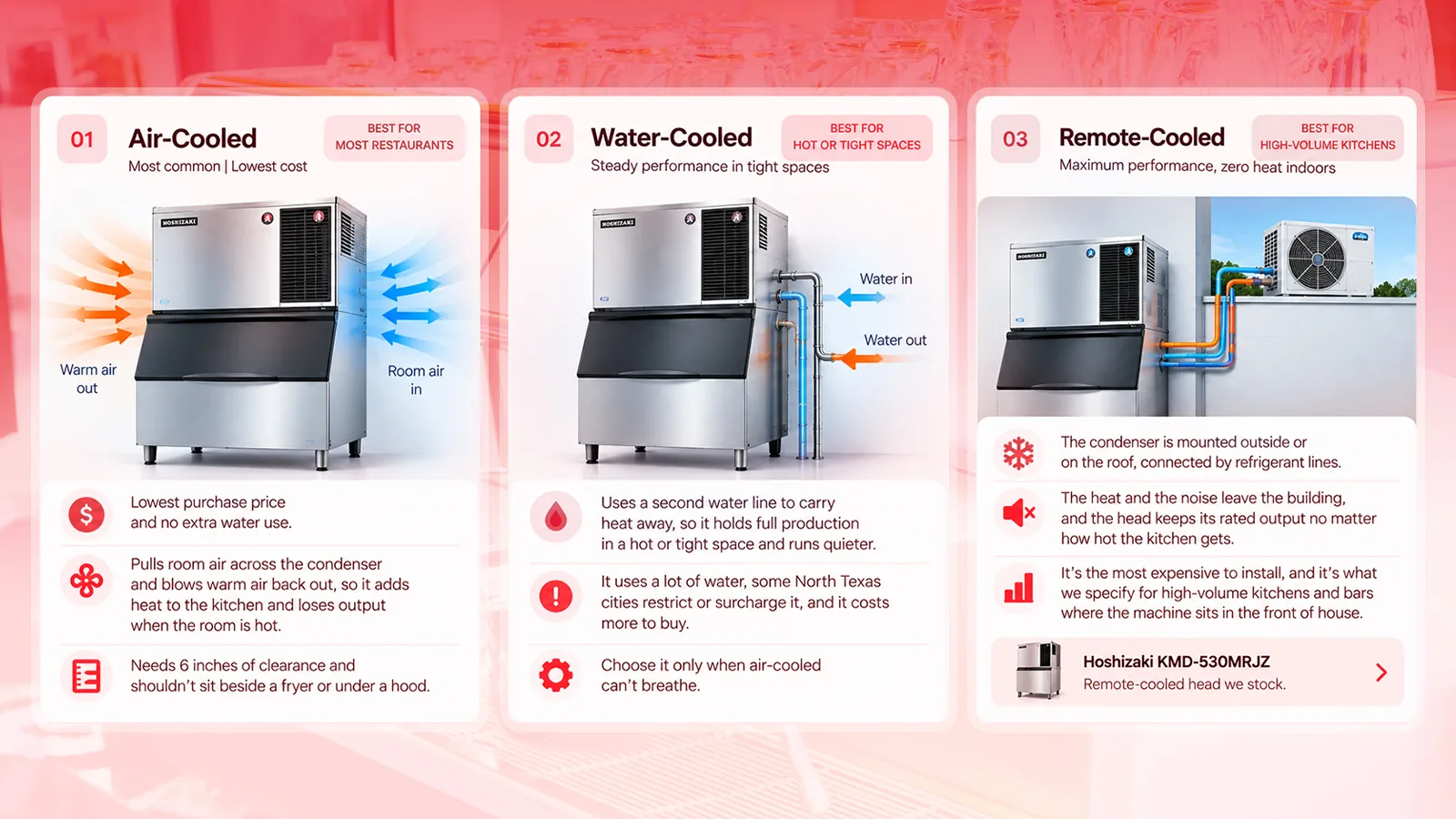
Air-cooled ice machines are the right choice for most restaurants because they cost the least to buy and run, as long as they have six inches of clear space around the intake and exhaust and a room that stays under 80°F. Water-cooled and remote-cooled units exist for the kitchens that can’t give them that.
- Air-cooled. Lowest purchase price and no extra water use. Pulls room air across the condenser and blows warm air back out, so it adds heat to the kitchen and loses output when the room is hot. Needs 6 inches of clearance and shouldn’t sit beside a fryer or under a hood.
- Water-cooled. Uses a second water line to carry heat away, so it holds full production in a hot or tight space and runs quieter. It uses a lot of water, some cities restrict single-pass water cooling, and it costs more to buy. Choose it only when air-cooled can’t breathe.
- Remote-cooled. The condenser is mounted outside or on the roof, connected by refrigerant lines. The heat and the noise leave the building, and the head keeps its rated output no matter how hot the kitchen gets. It’s the most expensive to install, and it’s what we specify for high-volume kitchens and bars where the machine sits in the front of house. The Hoshizaki KMD-530MRJZ is the remote-cooled head we stock.
The decision is really about where the machine will live. That’s a kitchen-layout question, and it’s easier to answer on the plan than after the walls are up; our commercial kitchen design team places the ice machine, the drain, and the airflow together for exactly that reason.
Commercial Ice Machine Cost in 2026
A commercial ice machine costs $2,000 to $4,500 for an undercounter unit with a built-in bin, $3,000 to $6,000 for a modular head in the 300 to 500 pound range, and $8,000 to $15,000 for high-capacity systems, with a separate bin adding $1,500 to $2,500. The price per pound of daily output falls as the machine gets bigger, which is why a slightly oversized unit is rarely a mistake.
| Setup | Daily output | 2026 price band |
|---|---|---|
| Small undercounter, import brand | 100 to 300 lb | $1,500 to $2,500 |
| Undercounter, Hoshizaki or comparable | 125 to 300 lb | $3,000 to $4,500 |
| Modular head, air-cooled | 300 to 600 lb | $3,000 to $6,000 |
| Modular head, remote-cooled, plus condenser | 500 to 1,000 lb | $5,000 to $9,000 |
| High-capacity head, 1,000 lb and up | 1,000 to 2,500 lb | $8,000 to $15,000+ |
| Storage bin, 300 to 900 lb | n/a | $1,500 to $2,500 |
| Water filter system | n/a | $150 to $500, plus cartridges |
Two costs live outside the price tag. Sales tax in Dallas is 8.25 percent, so a $4,000 unit carries $330 in tax. And the operating cost of an air-cooled unit includes the heat it dumps into a room you’re paying to air-condition, which is part of why remote-cooled pays back in a busy Texas kitchen. Ice machines qualify for equipment financing, and we price-match, so the number on the tag is the number to compare.
Ice Machines in Stock at RHQ
These are the units on the floor in Garland as of this writing, in order of daily output. Every one ships nationwide and every Hoshizaki carries the factory five-year compressor parts warranty.
| Model | Type | Ice / 24 hr | Bin | Width | Store price |
|---|---|---|---|---|---|
| Hoshizaki KM-116BAJ | Undercounter, crescent, air-cooled | 125 lb (100 AHRI) | 53 lb built in | 24″ | about $3,025 |
| Hoshizaki KM-161BAJ | Undercounter, crescent, air-cooled | 163 lb (123 AHRI) | 78 lb built in | 24″ | about $3,320 |
| Hoshizaki KM-231BAJ | Undercounter, crescent, air-cooled | 213 lb | 80 lb built in | 24″ | about $3,595 |
| Atosa YR280-AP-161 | Undercounter, half-dice, air-cooled | 283 lb | 88 lb built in | 24″ | about $2,385 |
| Hoshizaki KM-301BAJ | Undercounter, crescent, air-cooled | 290 lb | 100 lb built in | 30″ | about $4,200 |
| Atosa HD350-AP-161 | Hotel dispenser, air-cooled | 350 lb | 160 lb built in | 23″ | about $3,910 |
| Hoshizaki KMD-530MRJZ | Modular head, crescent, remote-cooled | 498 lb (440 AHRI) | Pair with B-500SF or B-700SF | 30″ | about $4,700 head; bins $1,725 to $2,140 |
Store prices on the day of writing; current prices are on each product page. Full range: commercial ice machines and Hoshizaki America.
How we’d match them: a 60-seat bar takes the KM-231BAJ or the Atosa YR280. A 150-cover full-service restaurant takes the KM-301BAJ at the bar plus a modular head on a 500 pound bin in the back, or the KMD-530MRJZ alone on a B-700SF if the kitchen is hot. A hotel or a self-serve beverage wall takes the HD350 dispenser. If the seafood case needs flake, that’s a separate machine, and we’ll spec it with the walk-in; see our walk-in coolers if that’s on the same order.
Installation and the Two Warranty Mistakes
An ice machine needs a cold water line at 40 to 100 PSI, a floor drain or drain line with an air gap, a dedicated circuit, and, for air-cooled units, six inches of open space on the intake and exhaust sides. Get those four things on the plan and installation is a morning’s work.
Two mistakes come up on almost every failed warranty claim we see:
- No water filtration. Dallas-Fort Worth water is hard, and scale builds on the evaporator until the machine freezes up or the harvest cycle fails. Manufacturers treat scale damage as a maintenance issue rather than a defect, and most require a filter and a documented cleaning schedule to honor a claim. A $150 to $500 filter system protects a $4,000 machine.
- Blocked airflow on an air-cooled unit. Installing it in a closet, under a counter with no vent cutout, or beside the fryer starves the condenser. Output drops, the compressor runs hot, and the failure that follows is classed as an installation problem. If the space can’t give six inches and cool air, buy water-cooled or remote-cooled instead.
Beyond that: clean and sanitize on the manufacturer’s schedule (every six months at minimum, quarterly in a busy kitchen), change filter cartridges on time, and keep the ice machine parts that wear, like the water pump and float switch, on hand for the model you own.
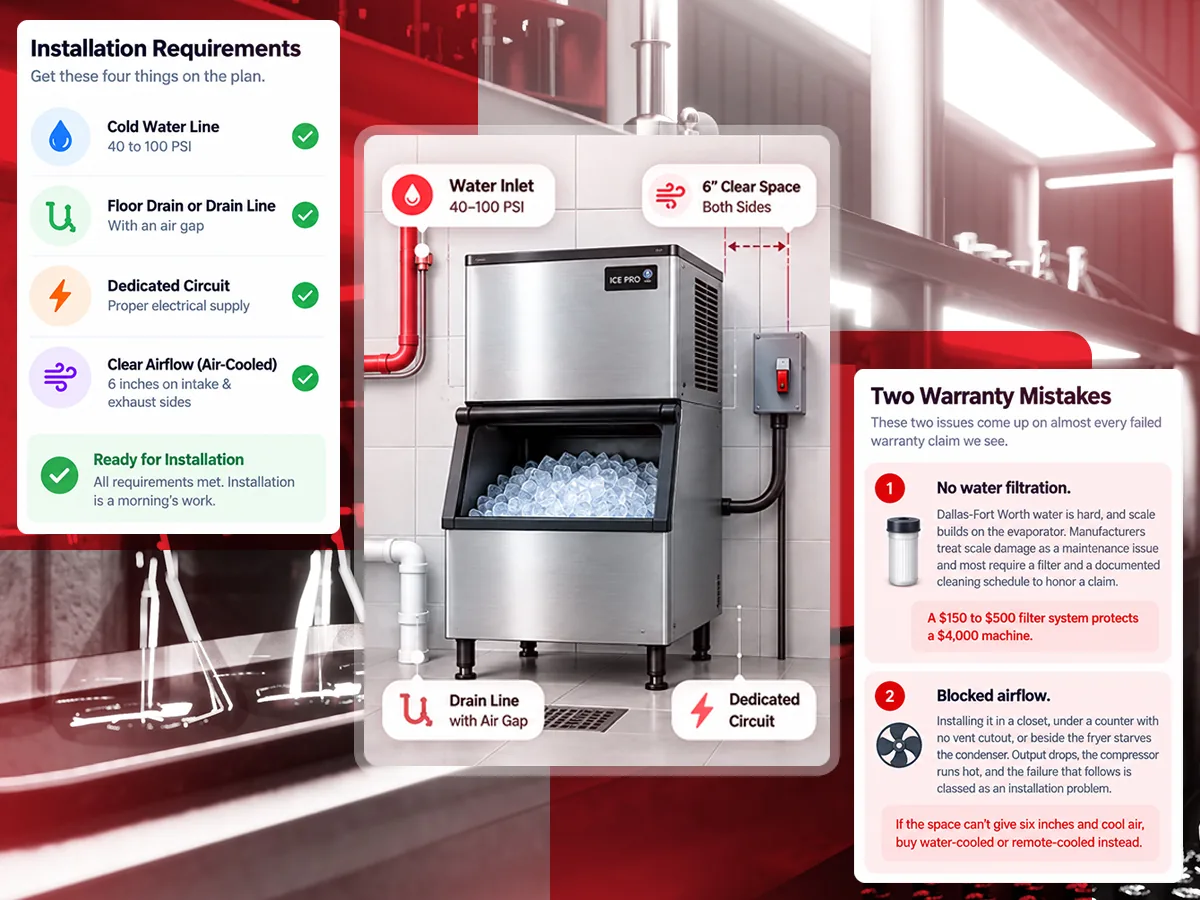
The clearance rule. Six inches of open air on the intake and exhaust sides of an air-cooled ice machine, in a room under 80°F. Ignore it and the machine loses up to a fifth of its output before it loses its warranty.
Frequently Asked Questions
How much ice does a restaurant need per day?
A restaurant needs about 1.5 to 2 pounds of ice per guest per day, a bar needs 3 pounds per seat, and a hotel needs 5 pounds per room. Restaurant Headquarters sizes from the busiest day of the week, uses the AHRI certified output rather than the headline rating for machines near the cook line, and recommends buying one size up.
How much does a commercial ice machine cost?
A commercial ice machine costs $2,000 to $4,500 for an undercounter unit with a built-in bin, $3,000 to $6,000 for a 300 to 500 pound modular head, and $8,000 to $15,000 for high-capacity systems, with bins adding $1,500 to $2,500. Restaurant Headquarters stocks Hoshizaki and Atosa units from about $2,400 to $4,700 with financing available.
Is an air-cooled or water-cooled ice machine better for a restaurant?
An air-cooled ice machine is better for most restaurants because it costs less to buy and uses no extra water, provided it has 6 inches of clearance and a room under 80°F. Restaurant Headquarters recommends water-cooled or remote-cooled units only for hot, tight, or front-of-house locations where an air-cooled condenser can’t breathe.
What size ice machine does a bar need?
A bar needs about 3 pounds of ice per seat per day, so a 60-seat bar needs roughly 180 pounds plus whatever the dining room draws. Restaurant Headquarters typically fits a bar that size with a 213 to 290 pound undercounter unit such as the Hoshizaki KM-231BAJ or KM-301BAJ, which keeps the bin full through a Friday rush.
Do commercial ice machines need a water filter?
Yes. A commercial ice machine needs a water filter because scale from hard water, which is common across Dallas-Fort Worth, damages the evaporator and most manufacturers won’t honor a warranty claim for scale damage. Restaurant Headquarters recommends a filter system on every ice machine it sells and cartridge changes every six months.
How long does a commercial ice machine last?
A commercial ice machine typically lasts 7 to 10 years with filtered water, a cleaning every six months, and proper airflow, and neglected units often fail in 4 to 5 years. Restaurant Headquarters recommends a documented cleaning and filter schedule, which is also the maintenance record manufacturers look for when a warranty claim is filed.
Get the Right Machine the First Time
The right ice machine is the one sized to your busiest day, matched to your ice, and placed where it can breathe. Restaurant Headquarters stocks Hoshizaki and Atosa in Garland, ships nationwide, price-matches, and finances, and our design-build team places the machine in the kitchen plan so the drain, the water, and the airflow are right before it arrives. Call (972) 487-8888 or send us your seat count.
Shop ice machines or ask us to size one
In stock in Garland, TX, with nationwide shipping, price match, and equipment financing.