







A commercial deep fryer with hood pairs a fryer with the ventilation and filtration needed to safely handle grease, smoke, and odor. The modern version — a ventless fryer — builds that filtration and fire suppression right into the unit, so you can add fried food almost anywhere without cutting ducts through the roof or spending $5,000–$20,000 on a traditional hood. Here’s how to choose the right setup for your kitchen.
In this guide
Ventless vs. Traditional, at a Glance
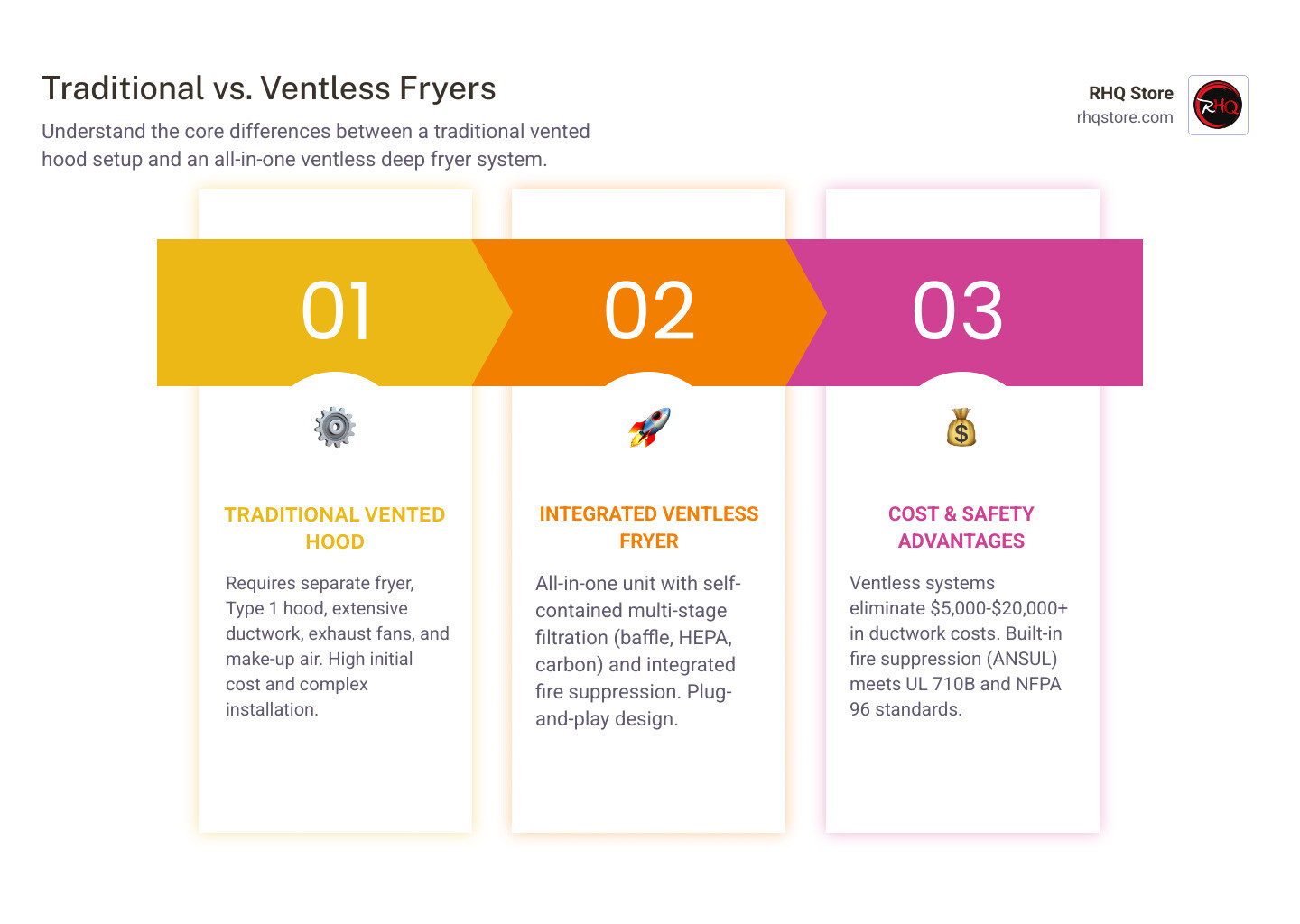
There are two ways to vent a commercial fryer. The traditional route uses a separate Type 1 hood with ductwork; the modern route uses a self-contained ventless deep fryer that filters and recirculates the air. Here’s the short version:
| Traditional setup | Integrated ventless system |
|---|---|
| Separate fryer + Type 1 hood | All-in-one unit |
| Requires ductwork to the roof | No ductwork needed |
| $5,000–$20,000+ for the hood system | Self-contained filtration |
| Specialized professional install | Plug-and-play (with proper hookups) |
| Separate fire-suppression system | Built-in ANSUL suppression |
What a Fryer-with-Hood System Actually Is
Any fryer that cooks in grease produces grease-laden vapor, which is both a fire hazard and a code issue. Managing it is non-negotiable — the only question is how.
The traditional setup: separate fryer and hood
A Type 1 hood (canopy or backshelf) captures the vapor and exhausts it outside through ductwork, an exhaust fan, and a make-up air unit, with a separate ANSUL fire-suppression system in the hood and ducts. It works well, but it’s expensive, space-hungry, and needs regular professional duct cleaning.
The modern setup: the all-in-one ventless fryer
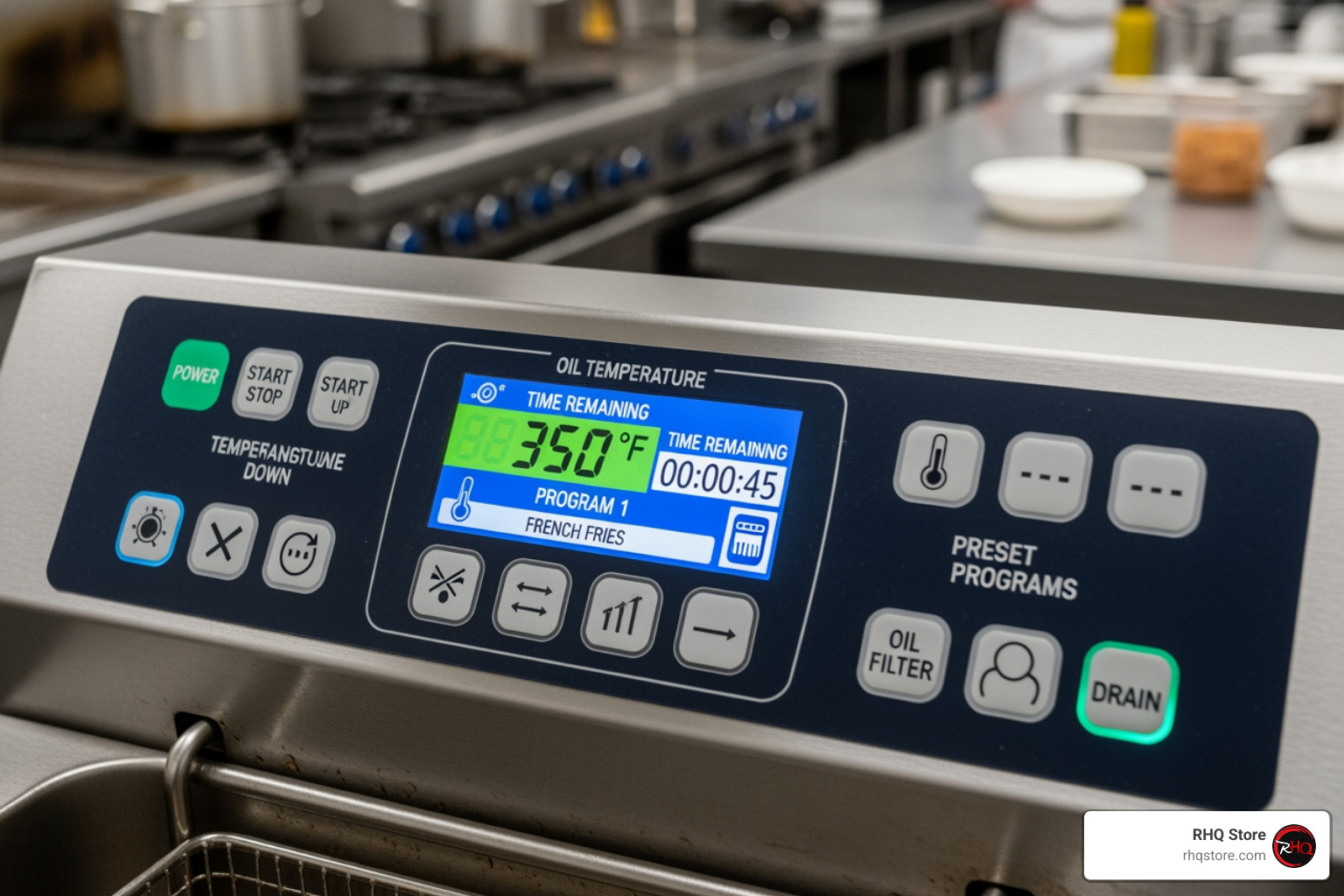
A ventless fryer combines fryer and hood into one cabinet and cleans the air instead of exhausting it — pulling it through a baffle filter (large grease), a HEPA-style filter (fine particulate), and an activated-carbon filter (odor), then recirculating it. Built-in fire suppression and safety interlocks shut the fryer down if a filter is missing or a fire is detected. These units are certified to UL 710B and NFPA 96, the same safety bar as a traditional hood.
Ventless Fryer Brands Compared
Four names come up again and again in the ventless world. Each is built for a slightly different kitchen:
| Brand | Best for | What stands out |
|---|---|---|
| Wells | All-purpose, higher volume | Auto-lift baskets, UL 710B, ANSUL R-102, filter interlocks |
| Perfect Fry | Compact countertop spots | Fully automated, small footprint, oil-saving filtration |
| AutoFry | Hands-off, food trucks & kiosks | Fully enclosed and automated, made in the USA |
| Giles | High-capacity, multi-purpose | Kettle and multi-purpose models, larger oil capacity |
There’s no single “best” — it comes down to your volume, your footprint, and whether you want a fully automated unit or a more conventional open-fry pot with a hood on top.
Why Kitchens Choose Ventless
For restaurants, food trucks, and ghost kitchens across Dallas–Fort Worth, a ventless system wins on three fronts: cost, flexibility, and safety.
What a traditional hood and ductwork can add before you fry a single basket. A ventless unit folds that into the fryer — and skips the ongoing duct-cleaning bills, too.
Real cost savings
Eliminating ductwork removes $5,000–$20,000 of upfront install cost. Long term, you skip professional duct cleaning and the energy drain of make-up air units, since the unit recirculates already-conditioned air — which also eases the load on your HVAC.
Install almost anywhere
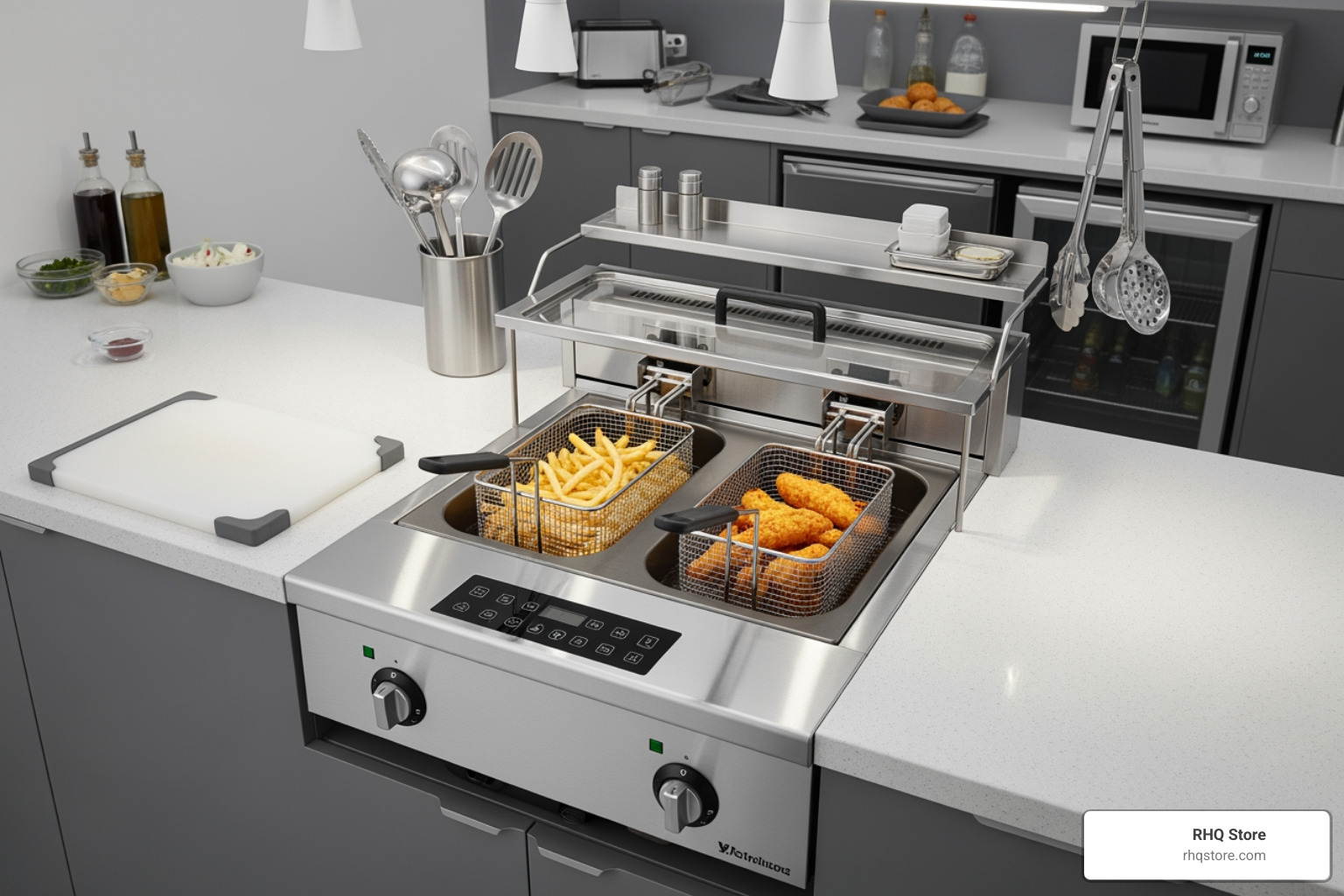
No ducts means you can fry in food trucks, kiosks, basement bars, and historic buildings where running an exhaust was impossible or cost-prohibitive. A small corner becomes a productive frying station — and a new revenue stream.
Simpler safety and compliance
Built-in ANSUL R-102 suppression and interlocks make unsafe operation nearly impossible, and the units ship pre-engineered to UL 710B, NFPA 96, and often NSF standards. For owners in Garland, Dallas, and North Texas, that usually means a smoother inspection. (Always confirm the specifics with your local fire marshal first.)
Key Features to Look For
Whether ventless or traditional, the fryer underneath has to fit how you cook. Match these to your menu and volume:
- Oil capacity: high-volume floor models hold 40–70 lbs; compact countertop units run 2–6 gallons.
- Power source: gas fryers (90k–150k BTU) heat fast for busy lines; electric fryers often recover quicker between batches and suit ventless designs.
- Recovery time: how fast oil returns to temperature after a cold drop — the difference-maker during a rush.
- Controls: manual is simple and rugged; digital adds precise temperature, melt cycles, and boil-out programs.
- Filtration & monitoring: on ventless units, look for a three-stage filter, indicator lights for filter changes, and tool-free filter access.
Going Traditional? Fryers We Carry
If your kitchen already has a Type 1 hood — or you’re building one in — you just need the right fryer to pair with it. These are commercial fryers we stock and can deliver across DFW:
- Dukers DCF3-NG Natural Gas Fryer — 90,000 BTU
- Dukers DCF5-NG Natural Gas Fryer — 150,000 BTU
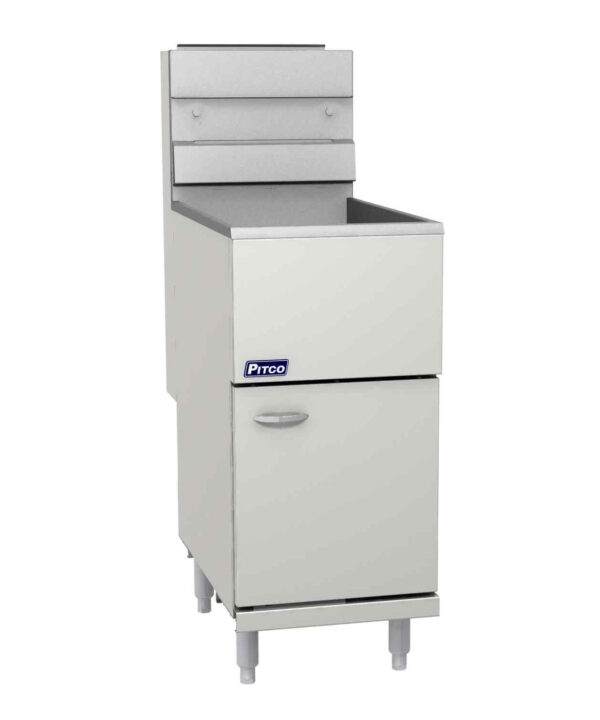
- Pitco SG14-S Gas Floor Fryer — 42–50 lb capacity
- Winco EFS-16 Countertop Electric Fryer — 16 lb
- Winco EFS-32 Twin-Well Electric Fryer — 32 lb
Want the full range? Browse our commercial fryers and gas fryers collections.
Not sure which fryer-and-hood setup fits your kitchen?
RHQ specs, supplies, and installs the right equipment — ventless or traditional — and handles the hood, ventilation, and permits as part of your build. One team, one quote, code-ready.
Keeping It Running
A simple, regular routine prevents costly breakdowns and keeps food tasting right.
Fryer and oil
- Daily: remove sediment from the cold zone so it doesn’t carbonize and turn oil bitter.
- Regularly: filter the oil to extend its life — many ventless units do this automatically.
- Periodically: run a boil-out deep clean. See our step-by-step guide on how to clean a deep fryer.
Hood and fire suppression
- Baffle filters: clean daily or weekly (usually dishwasher-safe).
- HEPA & carbon filters: replace per the manufacturer or when the monitor flags them — these aren’t washable.
- Fire suppression: the ANSUL system must be certified annually by an authorized distributor — a hard requirement for insurance and code.
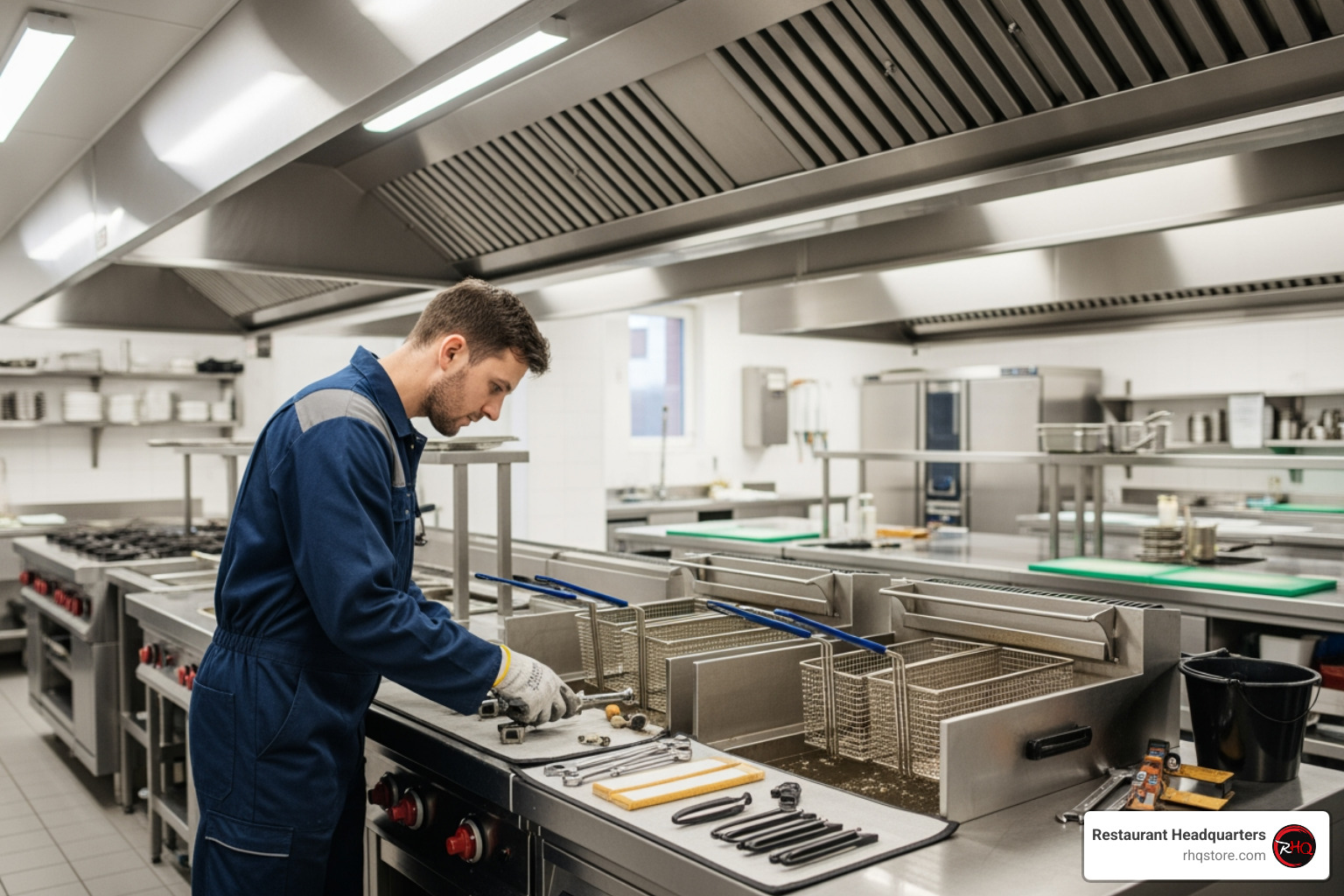
Prefer to hand it off? Our team handles restaurant equipment repair and maintenance across North Texas.
Frequently Asked Questions
Ventless, traditional, or air fryer — which is best?
For real frying volume, it’s ventless vs. traditional. Traditional Type 1 hoods make sense for very high-volume lines where you’re already cutting ducts. Ventless wins almost everywhere else — lower install cost, go-anywhere placement, built-in suppression. Commercial air fryers are great for low-grease, lower-volume items but can’t replace a true deep fryer for fries, wings, or breaded foods at scale.
Are ventless fryers electric or gas?
Most are electric, which is part of what makes them ductless and flexible — they only need the right electrical service. Gas ventless options exist but are less common.
Is there a small or compact ventless fryer?
Yes. Countertop ventless units (think Perfect Fry and AutoFry) are built for kiosks, bars, and food trucks where floor space is tight — you get a full fry station in a footprint not much bigger than a microwave cart.
How much does a ventless fryer cost?
Quality ventless systems typically run $12,500–$23,000. That’s more than a bare fryer, but a traditional fryer plus a hood system often costs more once you add $5,000–$20,000 of install — and ventless skips the ongoing duct-cleaning and make-up-air costs.
Should I buy a used ventless fryer?
Be careful. The value is in the filtration and fire-suppression system — and that ANSUL system must be re-certified by an authorized distributor before use. Factor that cost (and the condition of the filters and interlocks) into any used purchase.
What’s the difference between a Type 1 and Type 2 hood?
Type 1 hoods handle grease-laden vapor from fryers, griddles, and charbroilers — they include grease filters and fire suppression. Type 2 hoods only remove heat and steam from non-grease equipment like dishwashers. You cannot legally or safely use a Type 2 hood over a fryer.
Find the Right Frying Solution for Your Kitchen
Whether you go ventless or traditional, the goal is the same: a safe, code-compliant fry station that fits your space and your menu. RHQ helps restaurants across Garland, Dallas, and North Texas spec the right fryer and hood — and we can supply, install, and permit the whole thing as part of your build. Tell us about your kitchen and we’ll point you to the right setup.